

Cassandra
Inconvenient Indian author’s ‘Pretendian’ revelation breaks trust
'The audacity of a person to be able to take up that much space in the literary world to profess and postulate that they're one of us when they're not,' says prominent Dene communicator


Cassandra Blondin Burt hosts a discussion with Dëneze Nakehk’o of the Łı́ı́dlı̨ı̨ Kų́ę́First Nation about the recent revelations concerning Thomas King’s identity.
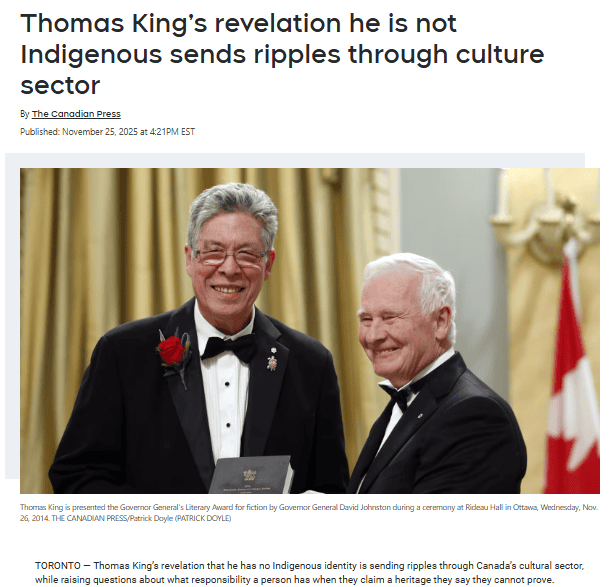
Ontario-based author Thomas King, whose books include 1993’s Green Grass, Running Water and 2012’s The Inconvenient Indian: A Curious Account of Native People in North America, wrote in a Globe and Mail essay published in November that he learned he has no Cherokee ancestry, despite having identified as Cherokee for most of his life.
Nakehk’o emphasizes the importance of honesty and integrity in Dene culture, highlighting the impact of King’s actions on trust within the community. He discusses the audacity of someone claiming to represent an entire community and the subsequent grieving process.
Nakehk’o calls for a shift in focus to highlight authentic Indigenous authors and scholars, emphasizing the need for healing and transformation. He also acknowledges the natural stages of grief — denial, anger, bargaining, and acceptance— as part of this process.
Here he is, in conversation with Cassandra Blondin Burt:
You’re listening to CKLB, 101.9 FM. I’m your host, Cassandra Blondin Burt and this is Medicine Stories.
Cassandra Blondin Burt: “We’re going to be speaking to a few different voices over the next little while, but we wanted to start here with touching base with you. Dëneze, in discussions about the recent news about Thomas King, somebody that so many people know and have referenced, and his work has traveled across the globe, really, in representing, you know, quote, unquote, indigenous literature and storytelling. I think this is a real not a shift in conversation, but another addition to a much longer conversation, a much wider conversation, and I’d love to hear from you about some of your thoughts about this recent news.
Dëneze Nakehk’o: “Oh, my God. There are so many different things, but I think can nail it down to like maybe three or four main things, you know, honesty and integrity, the audacity of taking up space, and also how much work people do in crafting a story. And a story where not only all of Canada, but lots of Indigenous folks kind of believe and buy into as well too. Honesty is key to Dene culture and values.

“We people of the land. We’re hunters. So, when you’re out there and then say, there’s two of us, when you use C-Dog (Clayton Bishop) as an example, say, C-Dog and I are out gonna go out camping or go out hunting for caribou, and the caribou are split up so and sea dogs like all right, and I’m gonna go around this big hill. I’m going to go follow this valley, I mean, and you’re going to go follow the river. It’s going to take us two days, you know, at the end of two days and two nights, when the moon is half full, I’ll get a meet at this creek that empties into this river in the valley. You need to be there. So, okay, and then I follow my path, and then two and a half days later, I get there, but C-Dog’s not there, so, and I wait. So I don’t know how long I have to wait. I don’t know if something has happened to him.
“So that honesty, integrity is so important, you have to do what you say. And then if you say something, you got to do it. Because in that situation, I don’t know if I’m putting C-Dog’s life in jeopardy. So how long do I wait? But like, How about my own life? You know, how long is it going to be in jeopardy for? How long do I have to wait to see? So, when we say things, you need to follow up, and we need to do those things so as part of essential to our culture, especially when we’re hunting for safety and all sorts.
“Reason is, honesty is huge and really important, and not only that of what you share, but how you follow up with that, it’s what sustained our people for millennia, for 1,000s of years. So, for someone or for something, to counteract that, you know, it’s a very violent act in a lot of different ways, and it and it kind of pulls the rug under underneath us, especially when it comes to trusting people with who they say they are and where they coming from. So, you know, that’s the big one. Also, Thomas King, you know, people are labeling him as a ‘Pretendian’, as somebody that’s pretending to be Indian who’s not actually doesn’t have any actually Indigenous blood, or is not part of any Indigenous community, thinking about the community that he claims he’s from, and how devastating that must be, how many supporters from that community must be like, ‘Look at this guy. He’s from our community. Look how well he’s doing.’
 “And then also in this story, there’s people that are always skeptical, that are always questioning different people. So, I feel for those people too, not in this moment. It’s like, I told you so, but like, how hard they fight to share from their perspective, but I guess, how hard people fight not to listen because it doesn’t fit the overall narrative, and it’s easier to believe this guy than those kind of, I guess, troublemakers or rabble rousers or people that just can’t leave good things alone, you know what I mean.
“So now there’s going to be, have to be some healing in that area as well too. It makes it harder for us to trust each other, I think, in a lot of different ways, but in that, in pretending to be from the certain community, and then having all your work based on that, you know the audacity of a person to be able to take up that much space in the literary world to profess and postulate that they’re one of us when they’re not.
“But you know, as a Dene person, when someone asked me to speak for my community, or maybe speak where my mom comes from, even though I can tie to my relatives and to my ancestors, going back to Treaty 8 and Treaty 11 in both those areas and before that, even if somebody asked me to speak for my community on something, I’m really hesitant because, you know, even though I’m Dene with strong ties to the community, and I know those things, sometimes I don’t feel like it’s my place to speak on behalf of my whole community on a certain issue. So, for me, like if somebody asked, so what is it? What is it? What is clearly, quite think, and I’m like, ‘Whoa, I can’t speak for my whole community,’ but, you know, from my perspective, these are some of the things I could share. But I’m really hesitant to speak up on behalf of like my community.
“And you know, I don’t want to speak on behalf of all Indigenous folks out there as well, too. So, for myself, you know it’s hard for me to step into that spot and say, hey, you know, I’m an Indigenous person, and this is how we do it. And you know, there’s, you know, even if I did do that, there’s probably people from my community saying, ‘Hey, why you doing that? You can’t speak on my behalf.’
“And then, so just to think it’s hard for me to get into the mindset of someone like Thomas King who can just like, get up there, get up there and speak on behalf of all of us. And so, the audacity of someone to be in that mind space, to be able to take on that role as being the one person representing all of us and all our stories.
“And just so the audacity of that, and they take, takes up so much space, so not only in the literary world, but academia, it’s part of syllabi. And then these are required reading for certain courses. You know that means that, you know, actual Indigenous authors from actual communities with strong connections, you know, they’re not taking up those spaces in the literary world, or part of, not, probably part of, not the same syllabi in those academic courses as well too.
“So, it takes up a lot of space for people that can actually probably do some good in those areas. So, you know, mostly when it comes to this, it’s those two things, and you know, part of this, it hurts a lot, because I think there’s a lot of people that viewed him as a mentor, you know, somebody that can help them on their journey in the literary world or other places.
“I know, I’ve cited Thomas King in presentations and workshops I’ve done. I’m sure a lot of people have used a quote or two, and then, you know, like for me now I, you know, I got to take that out, you know, I got to take all my references to Buffy Sainte Marie out, and all these other people who, at one time we were so proud of, so we were so proud of, but now I think we, you know, we’re kind of grieving how We feel that way, and I think that’s a natural thing, and then, and I think it’s important for us to be able to transform that and use that energy, maybe to shine a light and highlight all those authors in our communities that are doing good work, and highlight all those people that are doing good work. In academia that do have strong connections to the places we come from, and strong connections to our relatives and to our communities.
“And this is also hard for people that were scooped up or didn’t grow up in their communities. There’s a lot of people out there that are reconnecting, and this must be a big blow for them as well, too, because I think all of us, at one port, one point in time, because of colonization, go through a period of shame where we question our Indigeneity. Like, what is it? You know, how much of it is in me. You know, am I? Am I not? What makes me this? And I think those are all questions we probably all asked ourselves in the past. So, it’s like a gut punch when it comes to those reconnecting journeys and stories as well too, because, like, ‘Whoa. You know, if this person who professed so loudly that he was and it wasn’t, you know, what does that mean for individuals who are reconnecting, or just people who are trying to connect to their communities and their culture within their communities as well too?’
“But you know, I think speaking with you about this earlier. I think the perspective that you shared about you know, there’s going to be a space there open now that wasn’t, and I think it’s important for us to try to highlight and fill those spaces with the people that I think we’re doing a good job in those areas, not only doing a good job with but having stories that are so important for us to know and to understand, but these stories that come from our communities that are important for everybody in the entire world to know and to understand as well too.
“So, I think the focus should be kind of like, you know, highlighting those authors and working with them, and then trying to make it a safe space for those people that are doing good work. And then hopefully, you know, it won’t be just a space to occupy for one person, but maybe there’s a space they can occupy. You know, represent all of our nations in your communities as well too.
“So, when it comes to this, I think those are the main things. And I think about, but you know, also think about, you know, the grieving that goes on. And I just want to remind people, I think that it’s a natural thing to to work on. People are going to be sad. People are going to bargain with this. People are going to be angry. People are going to deny this and be in shock. Those are all natural things to help us process these things.
But once we get to the acceptance part, after grieving, then hopefully, then a lot of good things, and we can have a lot of actions and a good pathway forward.
Cassandra Blondin Burt: “Mashi cho to Dëneze for speaking with me on Medicine Stories.”