

Featured
Judge orders Akaitcho Process details to remain under wraps
Expert warns of a 'chilling effect' for the process, other treaty negotiations, if the draft agreement in principle became public

Some members of the Deninu Kųę́ First Nation in a 15-year legal battle with the federal government over their use of public lands on the the North side of the Ingraham Trail, won’t get to see the confidential Akaitcho Process Agreement in Principle (AIP) to help their cause.
On April 23, 2010, the NWT’s Commissioner started a trespass action against members of the Christensen family, alleging that they are trespassing on public lands located at the north side of the Ingraham Trail (Highway 4), state court documents.
Two years later, the Christensens legally denied they were trespassing and asserted they are entitled to occupy the lands in their traditional territory pursuant to Treaty No. 8.
The Christensens are members of the Deninu Kųę́ First Nation (Fort Resolution), one of four members of the Akaitcho Dene First Nations (ADFN), the others being Yellowknives Dene First Nation (Dettah and Ndilǫ), Łutsël K’é Dene First Nation.
In January 2023, the Christensens moved to convert their legal action into a proposed class action brought on behalf of First Nations members whose ancestors signed Treaty No. 8. That is still before the courts.
But as part of the latest related legal developments earlier this year, the Christensens asked the court to order the release of the draft Akaitcho AIP, claiming it has information that could affect the treaty rights to land.
Ottawa joined by the Commissioner, objected to any reference to the draft AIP, arguing the document, “is cloaked with settlement privilege and thereby confidential.”
NWT Supreme Court Justice Sheila MacPherson stated in her decision released November 7th that provisions in the draft AIP “may change significantly as the process for resolving claims in the Akaitcho Region continues” and “as a draft document, without legal effect, it has little probative value to the litigation as a whole.”
-

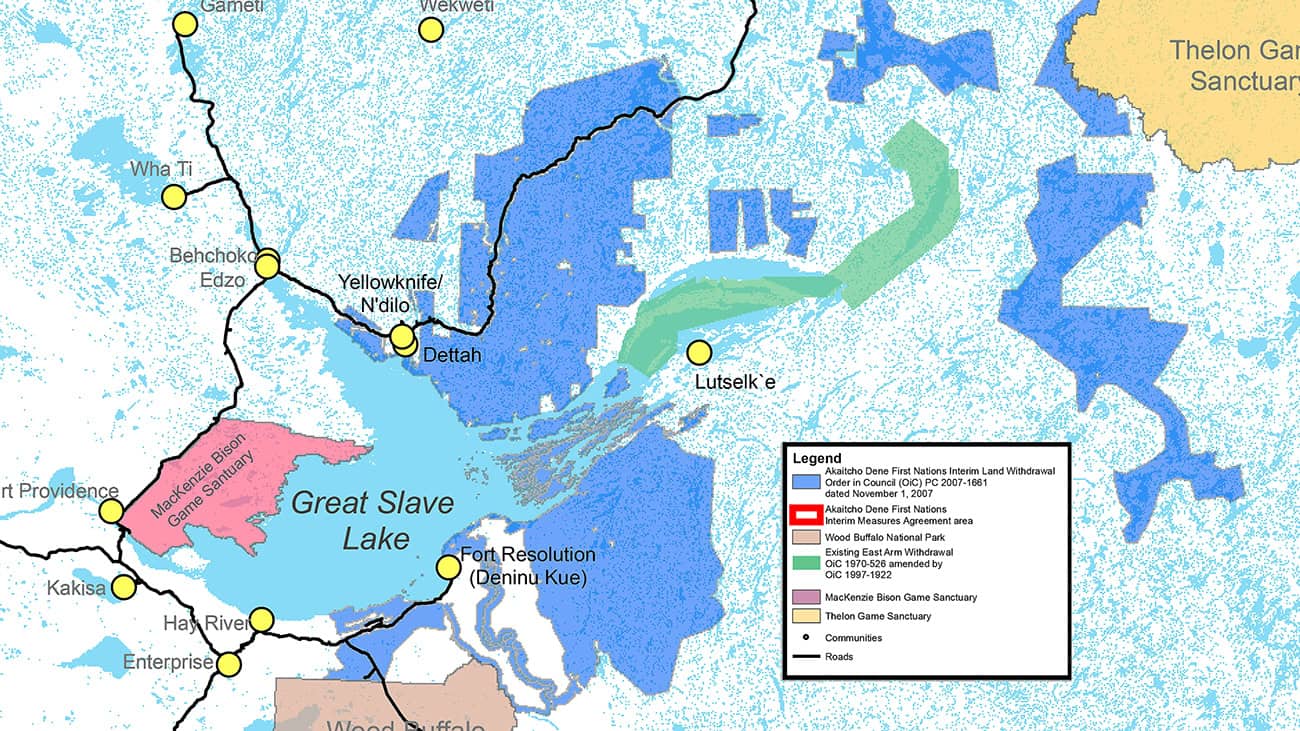
- Akaitcho Dene First Nation Interim Land Withdrawal Map of Commissioners land in Yellowknife. (Image: GNWT)
Treaty No. 8 was signed in June 1899 by the Crown and First Nations of the Lesser Slave Lake area.

Justice MacPherson stated the Christensens assert that they are the descendants of the signatories.
Treaty No.8 included a right, as an alternative to those who chose not to reside on reserve, to select 160 acres of land separately and that Canada has not done so.
The ADFN, Canada and the GNWT are negotiating the Akaitcho Comprehensive Claim Agreement focused on resolving the parties’ respective rights and obligations relating to land, resources and governance in the Akaitcho area, which covers portions of the modern-day North and South Slave Regions.
Canada accepted the Akaitcho land claim submission for negotiation in 1997 and a chief federal negotiator was appointed.
Canada, the GNWT and the ADFN entered into the Akaitcho Framework Agreement in 2000.
The Framework Agreement sets out the purpose, subject matters and process for the Akaitcho Treaty negotiations.
Agreement in Principle negotiations started in 2001 and are ongoing.
Justice MacPherson noted that in addition to being cloaked with settlement privilege, the Consultation Draft “was negotiated in the context of express confidentiality provisions contained within the Framework Agreement.”
The court heard from Patricia Eeles, a negotiator working for Canada, who outlined next steps in the Akaitcho Process.
They include the ADFN’ s internal review, as well as Canada and the GNWT using the draft AIP to consult with other Indigenous groups.
She advised that before any consultation occurs, the Indigenous groups must agree to maintain the confidentiality of the Consultation Draft.
Eeles asserted that confidentiality and privilege are essential to the effectiveness of the Akaitcho Treaty negotiation process, “as they provide all parties with the comfort that they can share their views openly and honestly and record their positions and points of agreement in writing as the negotiations progress, without fear that any written document will become public,” stated the decision.
“(Eeles) asserts that if the Consultation Draft were to become public in any manner, including by being filed with the Court and being relied on as evidence, it would negatively affect the Akaitcho Treaty negotiations,” and that “none of the parties in the Akaitcho Treaty negotiation process have waived confidentiality of the draft AIP.”
“Treaties are an important tool of reconciliation, and that, in essence, there would be a chilling effect on the negotiations for this process, as well as other treaty negotiations, if the negotiations were to become public.”
-

- Flying in an Air Tindi Twin Otter east of Yellowknife. These lands are part of the Akaitcho Process Interim Land Withdrawal agreement. (James O’Connor/CKLB)
Interim Land Withdrawal facts:
- The Interim Land Withdrawal of Commissioner’s Land in Yellowknife arose from an agreement between the Akaitcho Dene First Nations and the territorial government.
- The Interim Withdrawal of Commissioner’s Land brings clarity to some of the Akaitcho Dene’s interests within the City of Yellowknife
- Interim land withdrawals are not the same as land selections. They are a way to prevent the creation of new interests on withdrawn lands while negotiations proceed.
- An interim land withdrawal does not mean that all lands withdrawn can or will be selected.
- Land Selection negotiations generally occur closer to the completion of an agreement.
– source: GNWT